
Duality: March 2026
Exploring Duality at Moonflower Yoga & Ayurveda Studio in Brookfield
We shake with joy, we shake with grief
What a time they have, these two
housed as they are in the same body.
-Mary Oliver
Duality has been on my mind a lot lately — the quiet reality that life often asks us to hold two opposing truths at once.
Duality sometimes sounds like a philosophical idea. Something abstract. Something you might read about in a book. But the truth is, duality isn’t theoretical. It’s something we experience every day.
We feel it in our bodies — moments when we feel both strong and tired. Open and guarded. Grounded and restless.
We experience it in our emotions — joy mixed with grief, excitement alongside uncertainty. It’s possible to feel grateful for something while also acknowledging that it’s difficult.
Life rarely asks us to experience just one thing at a time. Learning to live with both at once may be one of the deepest practices we have.
The Dance of Opposites
Last month we explored the theme of challenge, and the idea that joy can still exist in the midst of difficulty. That reflection lives right here in the pairing of dukha and sukha — suffering and joy. Yoga philosophy has long recognized this dance between opposites.
In yoga, pairs of opposites appear again and again. Just a few examples:
Effort and Ease — Sthira and Sukha
Suffering and Joy — Dukha and Sukha
Solar and Lunar — Surya and Chandra
(A Sanskrit fun fact: the same word can hold different meanings depending on context! Sukha, for example, might describe comfort or ease in a yoga posture or a deeper sense of joy and well-being.)
Rather than trying to eliminate these opposites, yoga invites us to become curious about them.
Yoga philosophy reminds us that these experiences are not opposites that cancel each other out. They are part of the same human landscape. It’s possible to move through a challenging season while still feeling moments of gratitude, beauty, or connection.
And so in practice we explore how they can exist together.
The Practice of Non-Attachment
If duality is natural, where does the tension come from?
Often, it’s attachment.
When we experience something pleasant, we want it to last forever. When something uncomfortable appears, we push it away.
In the Yoga Sutras, the sage Patañjali describes this grasping as a klesha — a mental pattern that causes suffering.
Attachment pulls us toward one side of the pendulum. Avoidance pulls us toward the other.
And so we swing back and forth between extremes.
But yoga offers another path.
One of the ethical foundations of yoga — the yama of aparigraha — invites us into non-attachment.
Non-attachment doesn’t mean indifference. It doesn’t mean we stop caring or feeling. It simply means loosening our grip and allowing experiences to arise without needing to cling to them or push them away.
Practicing non-attachment can be tender work. When we begin to soften our grip on what feels comfortable or familiar, we may notice how strong the pull of habit and preference can be.
Compassion in the Unfolding
This is where compassion for ourselves becomes essential.
Learning to sit in the space between opposing qualities is a practice, and like any practice, it unfolds gradually. Some days we may notice ourselves clinging tightly to one side of the spectrum. Other days we might glimpse what it feels like to soften and allow both experiences to exist.
Both moments belong.
Aparigraha invites us to loosen our grip, but it also invites us to do so gently.
To meet ourselves with patience as we notice where we’re holding on.
To soften instead of judge.
To remember that awareness itself is already part of the practice.
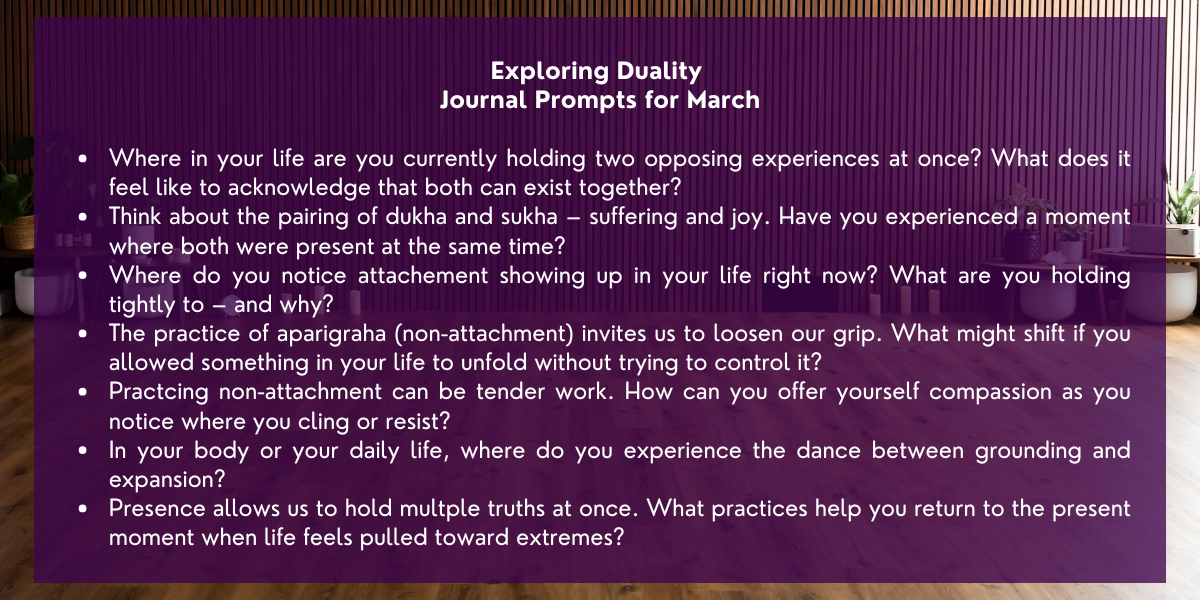
Living in the Space Between
In our yoga practice, exploring duality might look like:
pressing firmly through the legs while softening the jaw
holding effort in the body while the breath remains steady
feeling grounded and expansive at the same time
Off the mat, it might look like allowing both challenge and gratitude to exist in the same moment. Joy alongside grief. Strength alongside tenderness.
We begin to realize something important: Balance isn’t found by choosing one side of the spectrum over the other. Balance emerges when opposing qualities are allowed to coexist.
Somewhere between effort and ease.
Between suffering and joy.
Between solar and lunar.
There is space.
And often, the only way to notice that space is through presence — slowing down enough to feel what is here, just as it is.
When we pause and stay with the moment, we may begin to sense that quiet middle ground where opposing truths can exist together.
And perhaps that is where the real practice begins.
However this month meets you — with ease or effort, with heaviness or lightness — I hope you move through it with gentleness.
I hope you remember that both sides of the experience belong.
That softness is allowed.
That uncertainty is allowed.
That joy can exist alongside whatever else is present.
“We can suffer and sing at the same time. In fact, we must.” -Dr. Jaiya John
Lokah samastah sukhino bhavantu ~ May all beings everywhere be happy and free.
In loving kindness,
Katie